
The Angel's Silence
Poems and Thoughts from the Anxious Poet

The Angel’s Silence

The Talmud states that when the Egyptians were drowning in
the sea, the angels wanted to sing their daily song of praise to
God, and God quieted them: “The creations of My hand are
drowning in the sea, and you are singing songs?!”

Blessed are you Lord God,
Ruler of the Universe,
who has exhorted
that those who celebrate
a Passover dip their
spring parsley in salt water,
because compassion
comes only at the
fierce price of our tears
at another’s plight.

Blessed are you Lord God,
Ruler of the Universe,
who has exhorted
that those who celebrate
a Passover eat bitter
horseradish that makes
the throat ache, because
understanding
comes only through
the narrow place
called empathy.

Blessed are you Lord God,
Ruler of the Universe,
who has exhorted
that those who celebrate
a Passover remove
a drop of plenitude from
the cup of deliverance,
for each of the terrible plagues
that were visited
on the people of Egypt,
who are of the same womb.

Blessed are you Lord God,
Ruler of the Universe,
who has exhorted
that those who celebrate
a Passover open their doors
to any stranger in need,
or fleeing from violence,
or desperate for sanctuary,
as they could be Elijah
or perhaps just any
everyday anointed one.

Blessed are you Lord God,
Ruler of the Universe,
who has exhorted
that those who celebrate
a Passover remember
that the cost of freedom
can never, ever,
be the killing of innocents.

Blessed are you Lord God,
Ruler of the Universe,
who has exhorted
that those who celebrate
a Passover ensure
no victims are created
for another’s deliverance,
not in a gas chamber,
nor on a cross,
nor on a Gazan strip.

Blessed are you Lord God,
Ruler of the Universe,
who has exhorted
that those who celebrate
a redemption
in bread and wine,
in church or synagogue,
in call to prayer or worship,
in mosque or temple
never blind themselves
to a creation of your hand.

Blessed are you Lord God,
Ruler of the Universe,
who has begged
those who honour
your reign;
never to sacrifice
your creations
to a higher cause,
for your creations
are the higher cause,
and the reason for the angel’s silence.

,דֶסֶח ,The Hebrew word I would use for empathy is Chesed
“… a completely undeserved kindness and generosity”.

Written in honour of one of the most ancient religious
rituals in the human inheritance and having been invited by
a Rabbi to celebrate it as part of my training as a Catholic
priest in 1982, a ritual that continues to perplex me.
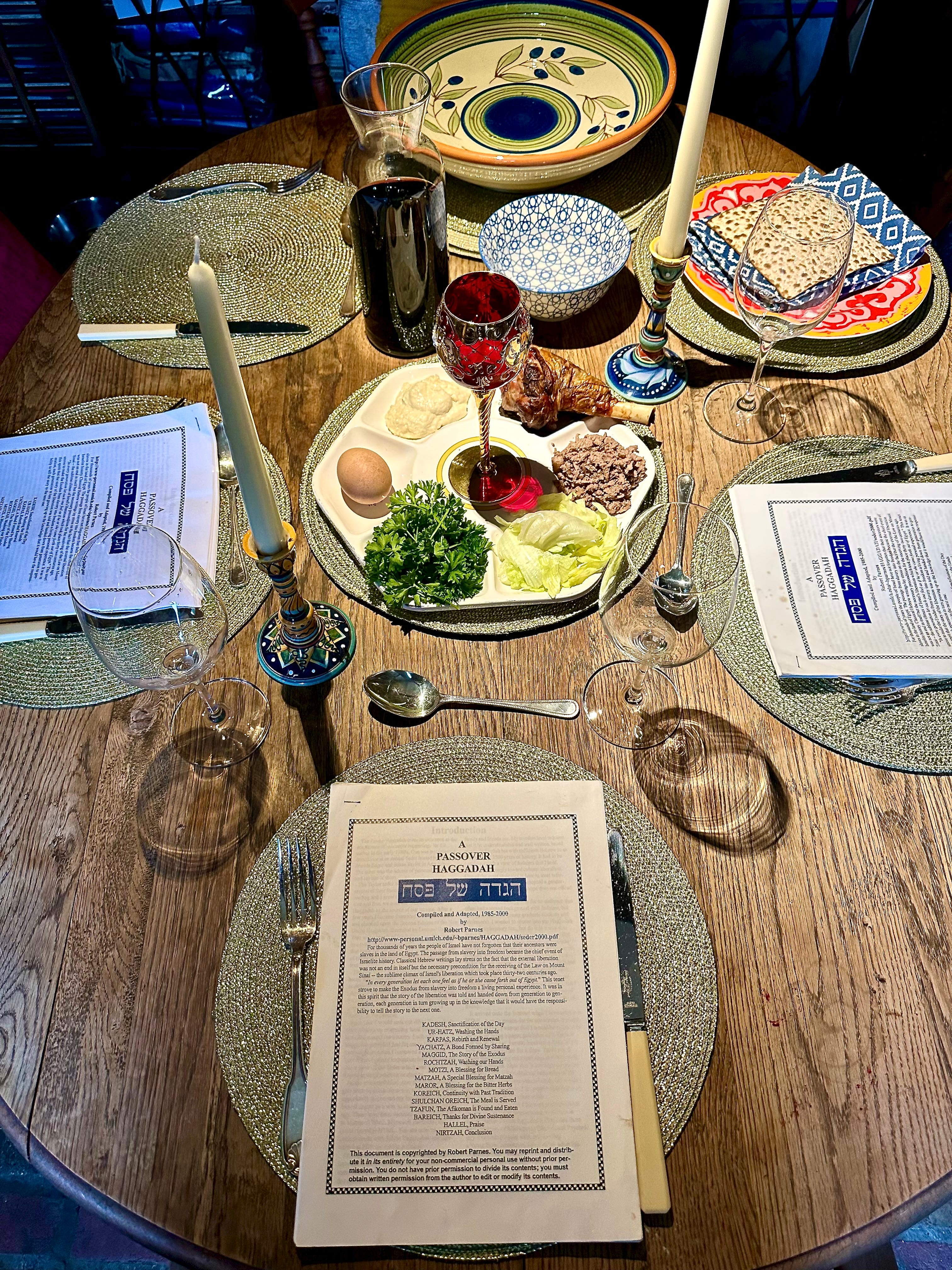
Every year we do this. Every year, I feel the ancient pull of a liturgy that dates back into prehistory. Every year, I feel the discomfort of engaging in a religious act that is not part of my Christian heritage. In fact, as we engage in this liturgy around our dining room table in our new house, most Christians will be in Church celebrating Maundy Thursday. So what am I doing? Setting a seder plate, making Haroseth, grinding a horseradish root, preparing salty water, eating spring herbs, roasting a lamb shank and an egg, and, of course, setting out Matzah (unleavened bread). Why on earth am I, a 65-year-old white man from the UK, a convert to Roman Catholicism in 1981, sitting down with my wife and daughter to celebrate Passover?
It all started way back in the early eighties. I was training for the Catholic Priesthood at the Mill Hill Missionary Institute in St Joseph’s College, up on the hill overlooking the M1. We had an excellent liturgy tutor, a nun, who wanted us to intimately grasp the theological scaffolding that supported the Christian Eucharist. Jesus, a Jew after all, celebrated the Passover with his friends the night before he died, during which he imparted the powerful Christian symbolism to the unleavened bread and cup of wine. Yet our tutor's contention was that they were already profound symbols that Jesus had overlaid, and if we didn't understand these, we would never truly understand the Mass we were being trained to celebrate.
She brought in a Rabbi from the local area who led us through a Seder, not as onlookers, but he invited us to participate as guests at the table he set for us. It was a revelation. We were told that this wasn’t a celebration to observe, it was a journey to be traversed. At the heart of this, essentially a family ceremony, observed in the homes of Jews around the globe, is the act of eating and drinking. Tasting the gruelling agony of slavery in the bitter herbs and the saltwater tears, the expediency of flight in the bread that had no time to rise. Experiencing the joy of freedom and an ancient Spring festival by eating greenery like lettuce and parsley, and the intoxication of wine. At the heart is the telling of the story of liberation as outlined in the book of Exodus. This is done in the classic Semitic question-and-answer form, and the children ask them if they are in the household.
What happened on that evening, and every time I have experienced Passover since, is the eliding of time; one is inserted into the odyssey of an oppressed people being led by the divine hand from the narrow place (mitzrayim) to the freedom of a given land, a home. I went back to Maltby from London, and we filled the parish room with bemused members of the congregation as we recited the ancient ritual. When I exited my training before ordination and had a family of my own, we carried on. In fact, it was the only religious ritual my kids genuinely enjoyed and asked to be part of. That is, until they were old enough to ask whether we were engaged in some strange cultural appropriation.
When my wife, Wilma, turned 60, we went to Venice. We fell in love with the quiet streets where only boats disturbed the still surface of the evening. We also found the original Jewish Ghetto moving and disturbing, sensing the ancient hatred that this diaspora always seems to evoke. Our journey home was on the Orient Express - a real treat. We ate all our many meals in the company of a Jewish couple, lawyers from Chicago, a little older than us, anglophiles, who often holidayed in London. We talked about many things and established a good rapport. Good enough for me to venture that we had our own seder every year. Far from disapproval, they expressed delight, telling us this was a compliment to their faith, that it was the most ecumenical of the Jewish festivals, and that they were encouraged to invite non-Jews to their Passovers. We have kept in touch ever since.
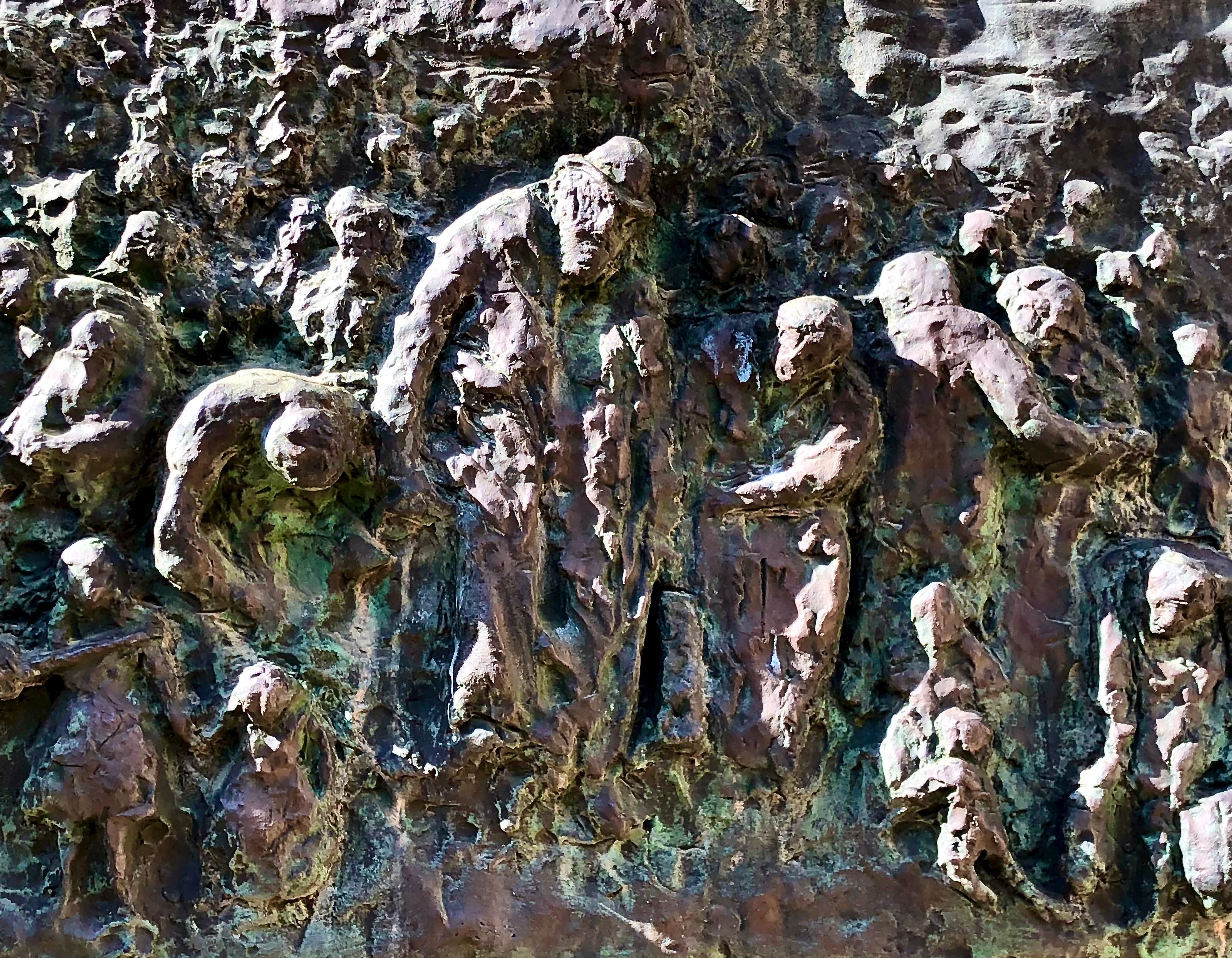
When I came to write my latest collection of poems, this astonishing and perplexing festival kept coming back to me. I worked on the poem you see above. Rather presumptuously, I took it on myself to take the form of prayer that is repeated over and over in the seder and wrote my own homage to these invocations. I had read the talmudic passage quoted at the head of the poem many times and felt deeply moved by it. I was also impressed by the taking of ten drops from a full cup of wine to symbolise the ten plagues visited upon the Egyptians in the story, as freedom won at the cost of others’ suffering is never full liberty.
In my Anxious Poet’s Podcast miniseries, I spoke last Wednesday of the depth charges that sit at the heart of so many religious traditions and challenge to the core the way we have, over the years, malformed, forgotten or, in the name of institutional self-protection, or nationalism, gone away from these powerful symbolic confrontations. This poem is my own poor attempt to remind myself of these foundational tropes. No tradition is immune to these deformities, it seems.
According to Google - ‘On April 1, 2026, during a White House Easter lunch, a pastor and spiritual advisor, Paula White-Caindrew, made direct comparisons between President Donald Trump and Jesus Christ, stating that Trump’s experiences with betrayal and false accusation mirrored those of “our Lord and Saviour”. The war in the Middle East illustrates just how far so-called religious countries can move from the core message of the religions they purport to practice.
Jesus’ injunction to do this in memory of me when breaking bread and sharing the cup is not some static remembrance but, in the Greek, ἀνάμνησιν (anamnēsin) - a remembrance that makes present. Just as Passover renders the ancient events so that the celebrants become one with them, so too those who remember a man who washed his friends’ feet, healed the sick, welcomed the outcast, deplored violence, and taught that change comes through self-sacrifice and love for others—whose greeting was “Peace be upon you”—are asked to become like him. These are the depth charges that lay bare the gap between the values these celebrations augur and the way they are hijacked by forces that are demonstrably self-seeking. My poem seeks to counter this by asking us all never -
to sacrifice
your creations
to a higher cause,
for your creations
are the higher cause,
and the reason for the angel’s silence.
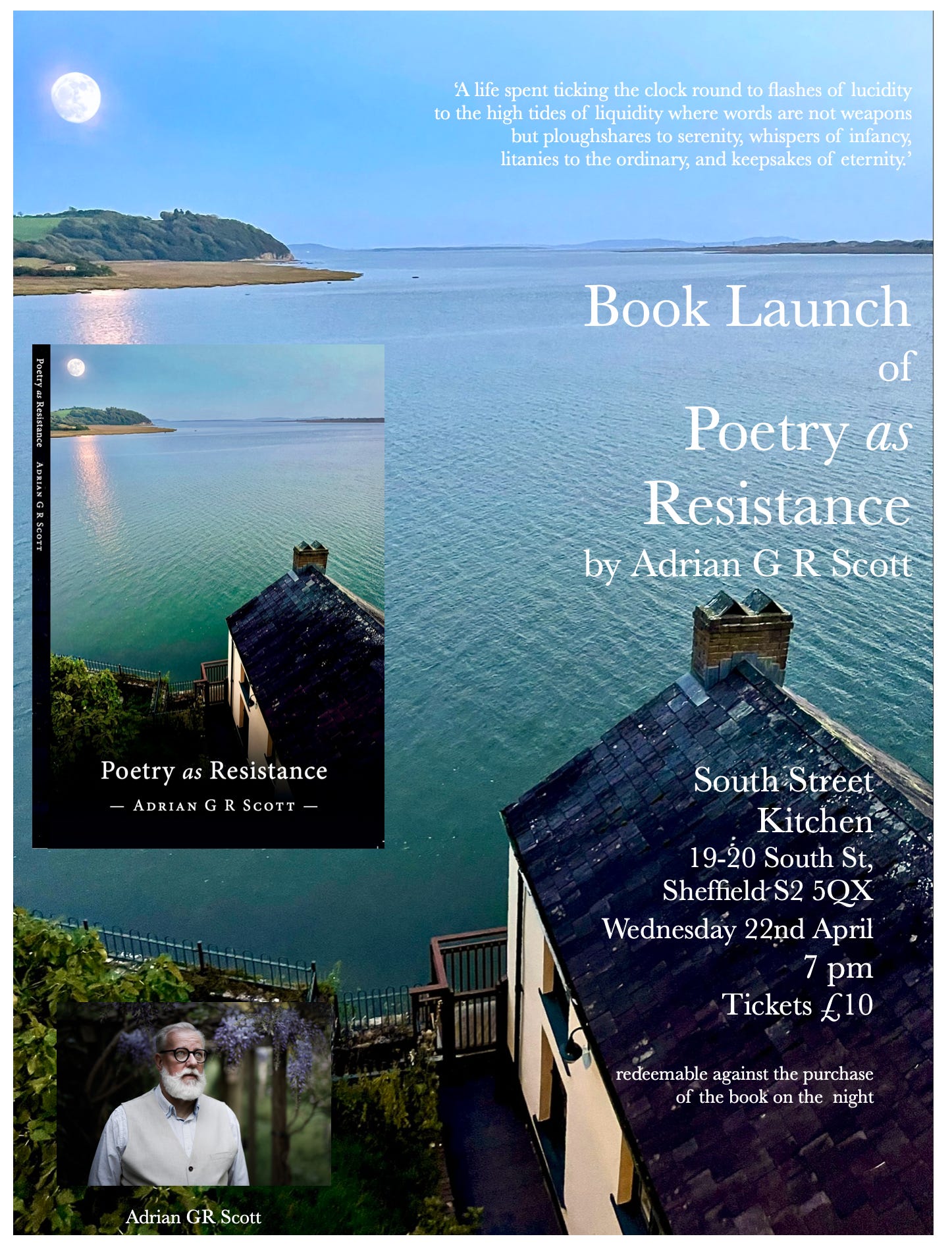
I will be launching this new collection, Poetry as Resistance, on April 22nd to bolster our inner resistance to these times and explore how poetry can help us live our one wild and precious life. To find ways in which resistance can change the world around us and reconnect us to the deeper spiritual traditions that always challenge us to be the best of human beings. If you are in and around Sheffield, please come along - tickets available by Clicking Here. The book will also be available on that date for purchase on my website, www.adriangrscott.com.
Wishing you all a happy Easter, a happy Eid, a blessed Passover and a joyful Spring. May we all find freedom from the narrow places (mitzrayim) that trap, damage, and kill human beings, and find ways to bring and live the peace, which is the greeting of all great Abrahamic faiths. Peace be with you.