
Elephants
Poems and Thoughts from the Anxious Poet

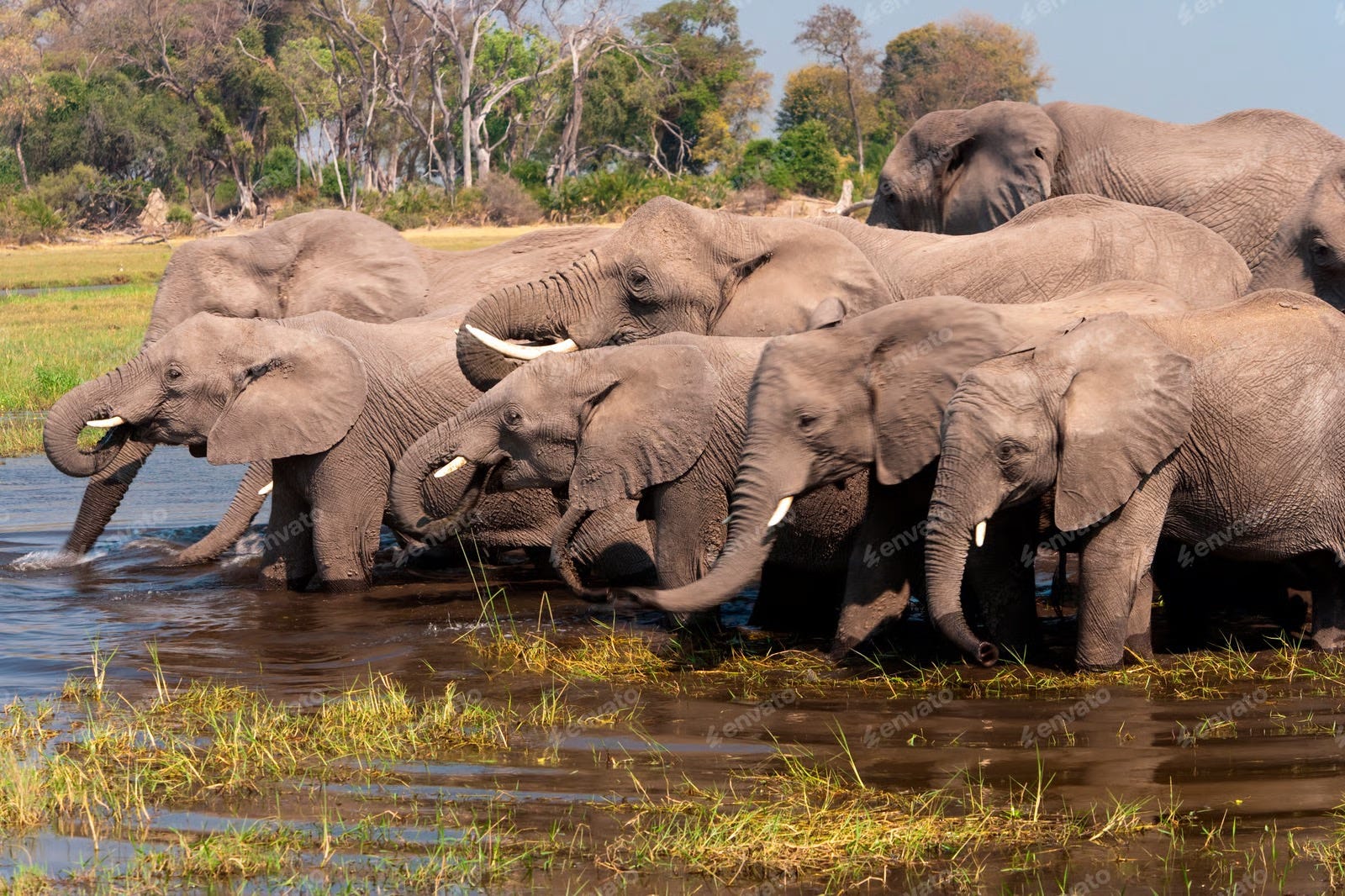
Elephants
We sit on the bank of the silted delta
in the three generations of my family
and watch the pachyderms browsing
on the other bank, surveying us quietly.

Some force has given us the right
to separate them out, those to stay,
those to die and those to migrate,
imposed on us like a judge’s black cap.

The call was one we couldn’t accept,
we were too related to think that
we should judge other mammals
whose lifespan matches our own.

I sensed that there was an offer,
an invitation to incarnation,
to become one of them, to feel
for myself their deepest instincts.

I entered the waters of the delta
feeling the dermal transfiguration,
my skin thickening and my weight
shifting, yet breasting the currents.

The herd watched me and as one
descended the bank and surrounded
me with their generations, with the
wisdom that streams from their past.

As my empathy adjusted to that
of a great beast, speaking in
a rumbling, growling, trumpeting
voice from my great leathery thorax.

I realised as we wallowed together
that they appreciated death and
carried all the souls of their lost
in profound stores of memory.

We begin to form into a line
and head out towards the lagoon,
a luminous blue-green expanse,
each following in the other’s wake.

I realised that what mattered
wasn’t being selected out, no,
it was being part of that string,
a line flowing from a shared story.

Through iteration after iteration
and on through the shimmering
green-blue seas, leaving a lit trail
of glow-wormed incandescence.

Grey bodies carrying ancestors
in their genes, inherited souls,
sweeping into the unknowable,
living the life of the whole herd.
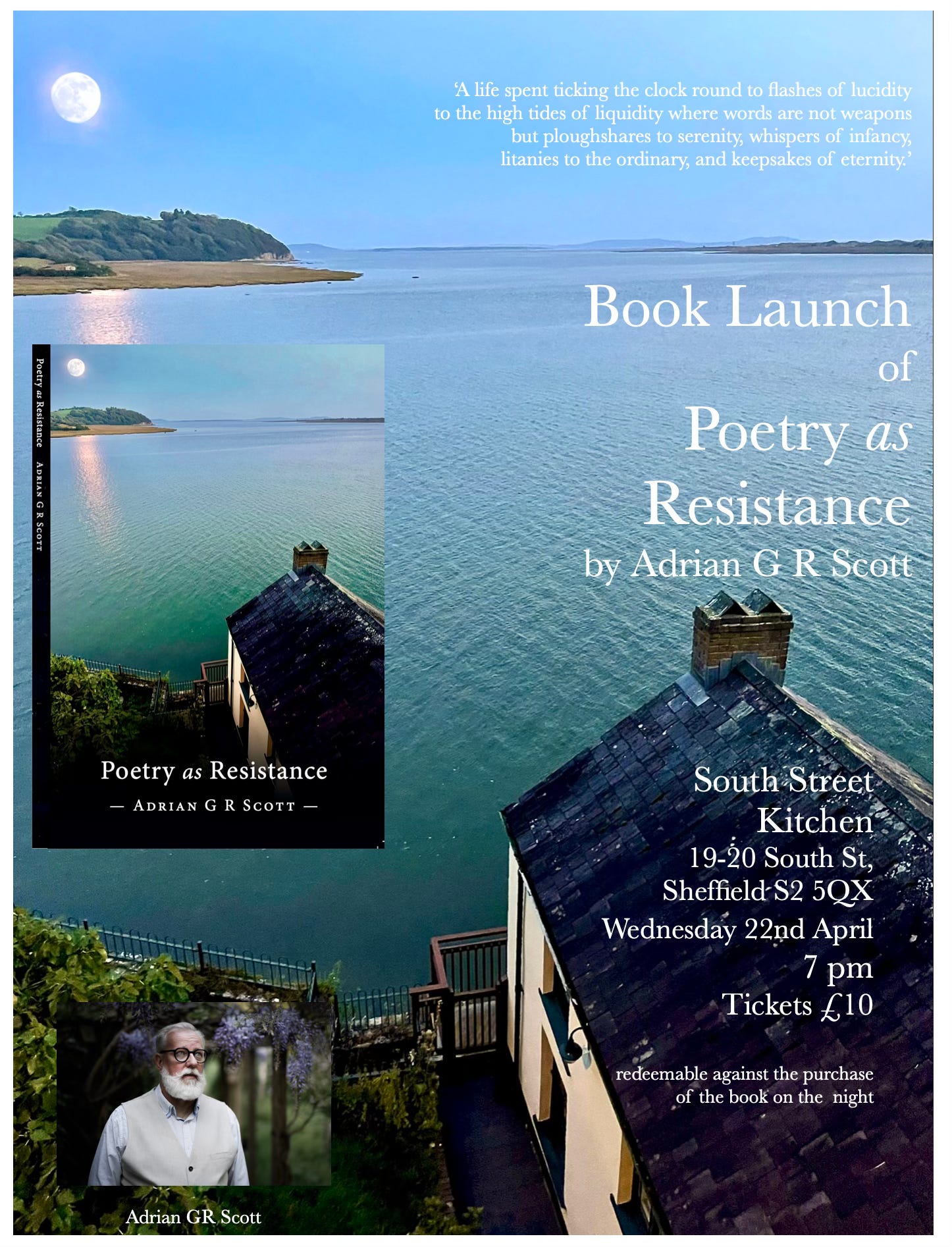
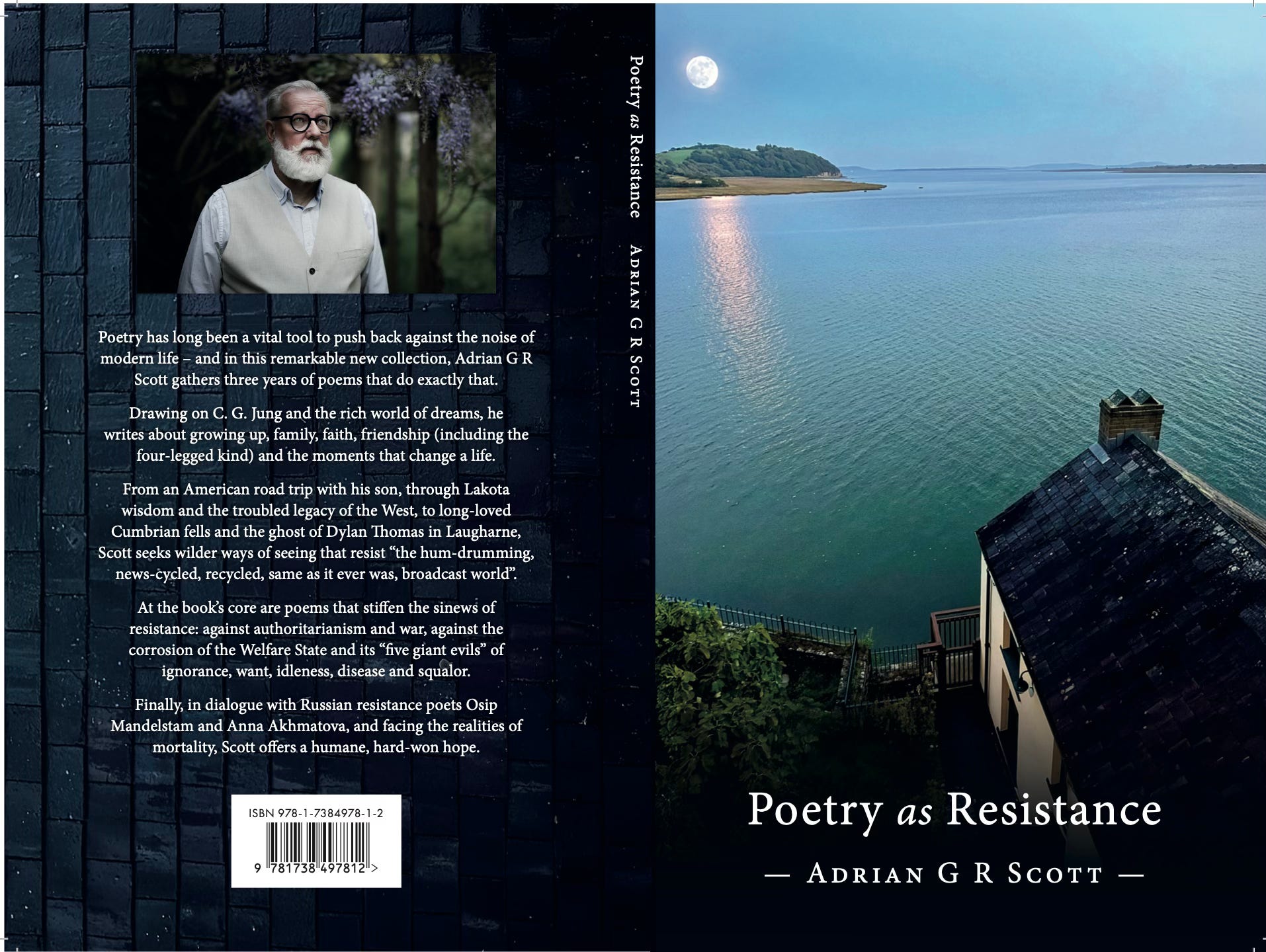
This is the first moment of reflection I have had since the launch of my new collection, Poetry as Resistance. We had nearly sixty folk crowded into the lovely South Street Kitchen in Sheffield’s iconic Park Hill Flats. Poetry was performed, songs were sung, and books were signed and sold. The sun shone through the windows, offering a fine view of the city and creating a lovely spring feel to the occasion. So many faces looking up at me as I attempted to articulate where the idea of Poetry As Resistance came from. My two daughters in the front row, my wife singing next to me, some of my oldest friends at the back, all kinds of creative people, including Andy from our Band Dusk Over Rivelin, who accompanied some of the poems and Wilma’s singing. I was deeply touched by the variety of people who have become an intimate readership.
I recounted the way poetry had found its way into my life fifty years ago. I shared that I had failed miserably at school, and my old friend Graham, a classmate, confirmed my poor performance. However, the one academic triumph was an O-level in English Literature, mainly due to one poet, Dylan Thomas.
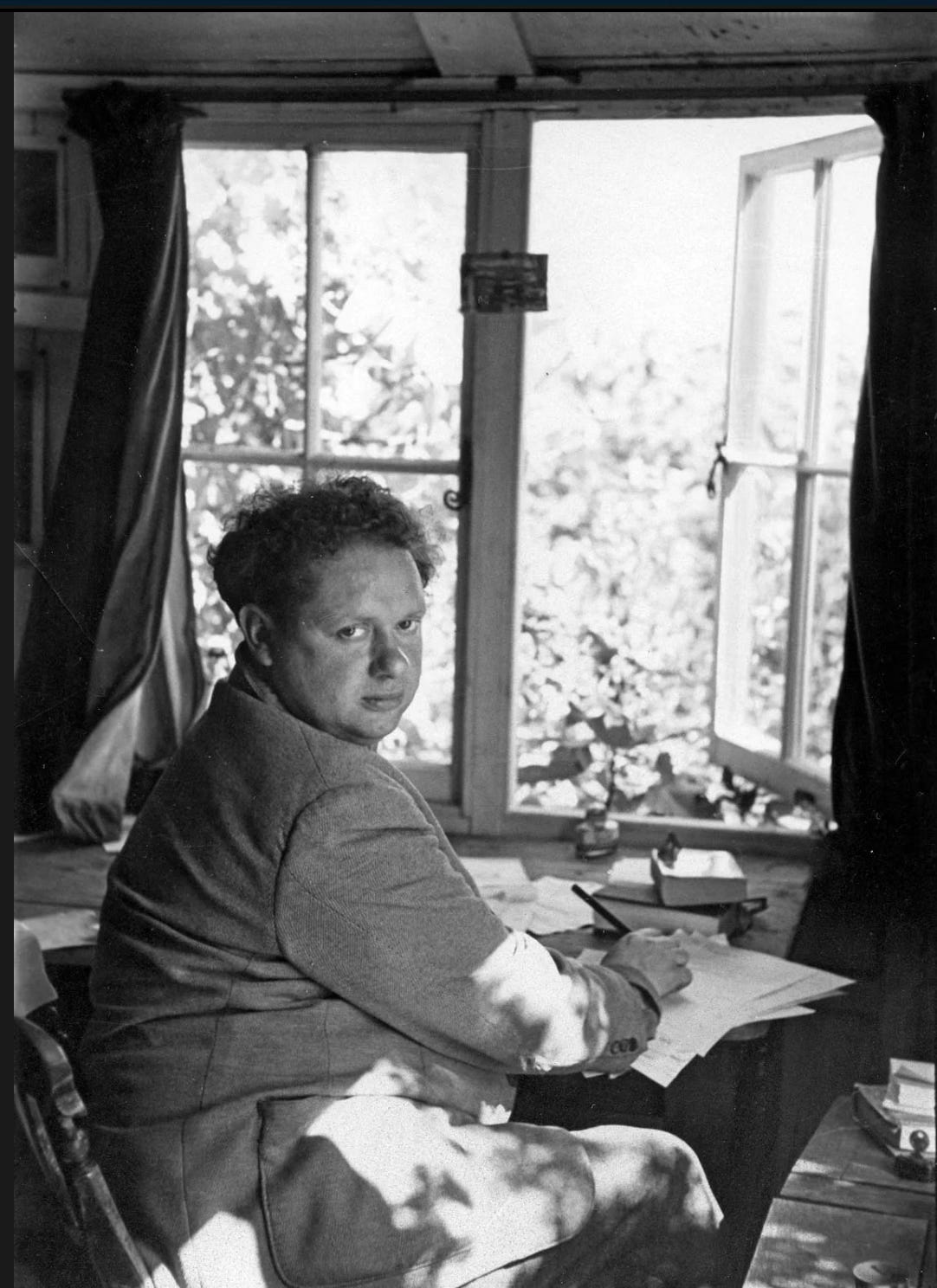
Something about these lines captured my young imagination.
Now as I was young and easy under the apple boughs
About the lilting house and happy as the grass was green,
The night above the dingle starry,
Time let me hail and climb
Golden in the heydays of his eyes,
And honoured among wagons I was prince of the apple towns
And once below a time I lordly had the trees and leaves
Trail with daisies and barley
Down the rivers of the windfall light.
Fern Hill - Dylan Thomas
I did not fully understand what they meant, but their music — their pure lyrical wonder — exploded in my imagination and made me realise that poetry was like a depth charge in the psyche, whose reverberations could be felt both under the water and, gradually, on the surface of my life. I recounted how, at the age of fifteen, I went on holiday to Carmarthenshire with my mother and her new partner in his purple Triumph Stag. When he fell ill in the first week, we were stranded for a further six weeks until he was well enough to travel. Someone in the local pub mentioned that Dylan Thomas had lived along the coast in Laugharne, and that there was a museum dedicated to his work. Off we went in my Auntie Doll’s little Mini along the winding roads to see it. I remember peering into his preserved writing shed and thinking how wonderful it would be to live the life of a poet, without knowing what that actually entailed.
In a fifteen-year-old body
I came to the Gower,
my unknowing outweighing
any gift with words,
but I was ignited by Dylan.
From We Are Summer’s Children - in Poetry As Resistance
It took me until I was fifty to take the plunge and seek a life in which writing, especially poetry, became a daily expereince. It worked its way into my life, and I realised that the discipline it required led me into my inner world. The fact that I also had a breakdown in 2014, which led me into Jungian analysis, abetted this inward journey. Hence the moniker The Anxious Poet: I realised that I could write into, through, and out of my breakdown. It was deeply cathartic to chart the dimensions and vulnerabilities of my Night Sea Journey. Dreams being the stuff of analysis, I began to work with my nocturnal visitations. The poem above is the fruit of that wrestling, as are many of the other poems in the I Dreamed a Dream section of the collection.
So where do dreams come from?
Questions to be grappled with, like Jacob,
until the envoy agrees to bless you with a revelation.
From Where Do Dreams Come From - in Poetry As Resistance
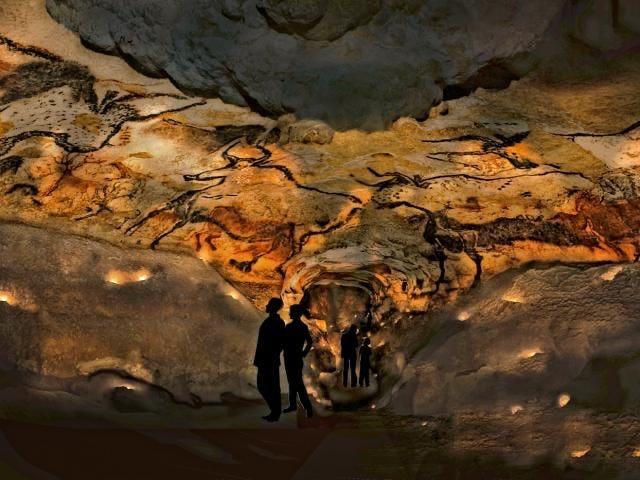
Some of my most seminal dreams, and those of many people, are of animals. I believe this connection goes right back into our ancestral history; it is in our DNA. If you look at the cave paintings in Lascaux—human art from 17,000 to 20,000 years ago, the Sistine Chapel of prehistory—you witness this symbiotic relationship between the other animals we share this planet with and us. For my 65th birthday, I subscribed to Resurgence & Ecologist, a beautiful periodical that seeks to reconnect us with the living planet. The May/June edition is all about Restorying the World, challenging the Hero Myth as a model for our relationship with the natural world—indeed, challenging the stories that posit our separation from nature, and asserting that we are nature and need to recalibrate that relationship. C.G. Jung, in The Red Book, has to kill the Hero as a way of deepening his relationship to the Self, or Soul, which is our deepest lodestone. My work with my dreams is my attempt at such a recalibration.
‘In taking this journey with story, we create the space and possibility for new kinds of story to emerge, which, as I hope I’ve shown, we need: relational, deeply patterned stories in the plural, that can hold us into the future.’
Changing the Story by Sarah Woods in May/June Resurgence & Ecologist.
I dreamed this dream of the Elephants a couple of years ago, and it has continued to move me deeply. Rendering it in poetic form helped in the process of active imagination advocated by Jungians. One of the processes involved in this, which my Analyst has schooled me in, is to look at both the biological and symbolic meanings of the animals that appear. A book like Elizabeth Caspari’s Animal Life in Nature, Myth and Dreams is a good reference. She says this of the Elephant.
The elephant’s unusual size, amazing strength and superior intelligence conjure up an image of what may actually be available to the dreamer in the personal unconscious, and give that person the courage to face the world in a more positive way.
The first part of the dream/poem addresses the unhealthy and exploitative model we, as Westerners, have inherited. The trouble can be traced right back to the way in which one of our seminal mythical texts has been interpreted. The text says that God gave human beings (made in God’s image and likeness) the Hebrew word is radah (רָדָה) commonly translated as "rule," "have dominion," or "subdue" the earth.
Then God said, “Let us make humankind in our image, in the likeness of ourselves; and let them rule over the fish in the sea, the birds in the air, the animals, and over all the earth, and over every crawling creature that crawls on the earth.”
Genesis 1:26 - From the Complete Jewish Bible
This is what I am referring to when I use the phrase ‘a judge’s black cap.’ The generations of my family were not ready to accept this imposed dominion. Modern scholarship translates this word radah (רָדָה) as responsible stewardship, active management, and delegated authority in the image of the divine. It represents what many describe as a God-given mandate to bring order out of chaos, cultivate potential, and care for creation as representatives of a loving Creator. Another word might be husbandry or guardianship.
My encounter with these astonishing creatures takes this a step further. It seems to me the unconscious was inviting me into an essential component of any sustainable future relationship. To enter the physicality that any good relationship requires was what the dream world invited me to do. In an amazing synchronicity, while preparing for the book launch, I happened to watch a National Geographic documentary called Searching for Africa’s Ghost Elephants.
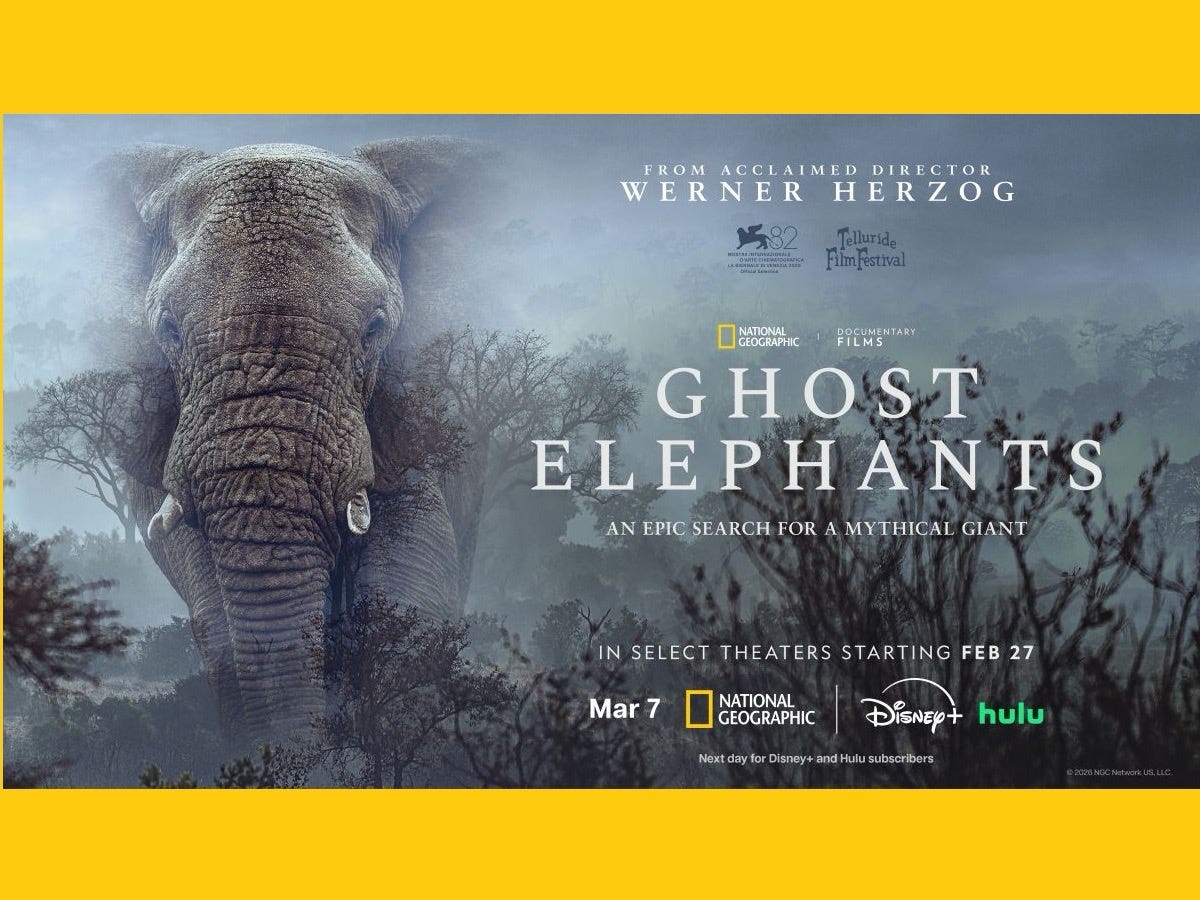
This amazing film follows Dr Steve Boyes as he searches for these huge elephants, which may be connected to their ancestors, the mastodons. They meet incredible Kalahari trackers whose traditions preserve these strands of mythical DNA in relation to elephants:
To drive home this sacred connection, he told us the myth of an elephant hunter who went to the Quembo River and came upon a herd. The hunter hid in a tree, and though the elephants passed beneath him, he didn’t shoot.
“Then, behind those elephants, there was another lonely elephant. When it reached the river, it removed its clothing—elephant skin—and started bathing. It was a human being now. She was a beautiful lady. The hunter climbed down and destroyed the elephant’s skin [so that the woman could not change back]. ‘Don’t kill me,’ she begged. ‘From now on, I’ll be your wife.’ The hunter took the woman to his village.”
The story speaks to the elephant’s importance in Indigenous Angolan culture.
My dream took the reverse journey: I became a pachyderm. My family became indissolubly connected to the elephantine by my decision to become one of them. If nothing else, this seemed an invitation to empathy. Not anthropomorphism—projecting our emotions and attitudes onto animals, what my friend calls the Dog Delusion, when I tell my dogs I will be back in an hour. No, this empathy is what might be called fellow feeling. David Abram, in his wonderful book Becoming Animal, expresses what I am struggling to say.
‘Nonetheless, the power of language remains, first and foremost, a way of singing oneself into contact with others and with the cosmos—a way of bridging the silence between oneself and another person, or a startled black bear, or the crescent moon soaring like a billowed sail above the roof. Whether sounded on the tongue, printed on the page, or shimmering on the screen, language’s primary gift is not to re-present the world around us, but to call ourselves into the vital presence of that world-and into deep and attentive presence with one another.’
Becoming Animal - David Abram
My dream/poem brought me into the deep, attentive presence of elephants and an exquisite awareness that is voiced in this stanza.
I realised that what mattered
wasn’t being selected out, no,
it was being part of that string,
a line flowing from a shared story.
We are not the masters of the story; we are co-authors with our fellow mammals, and indeed with all creation. Their threads are woven into our dreams, and we need to wake up and write them into the narratives of consciousness before we tragically and disastrously write ourselves out of it.
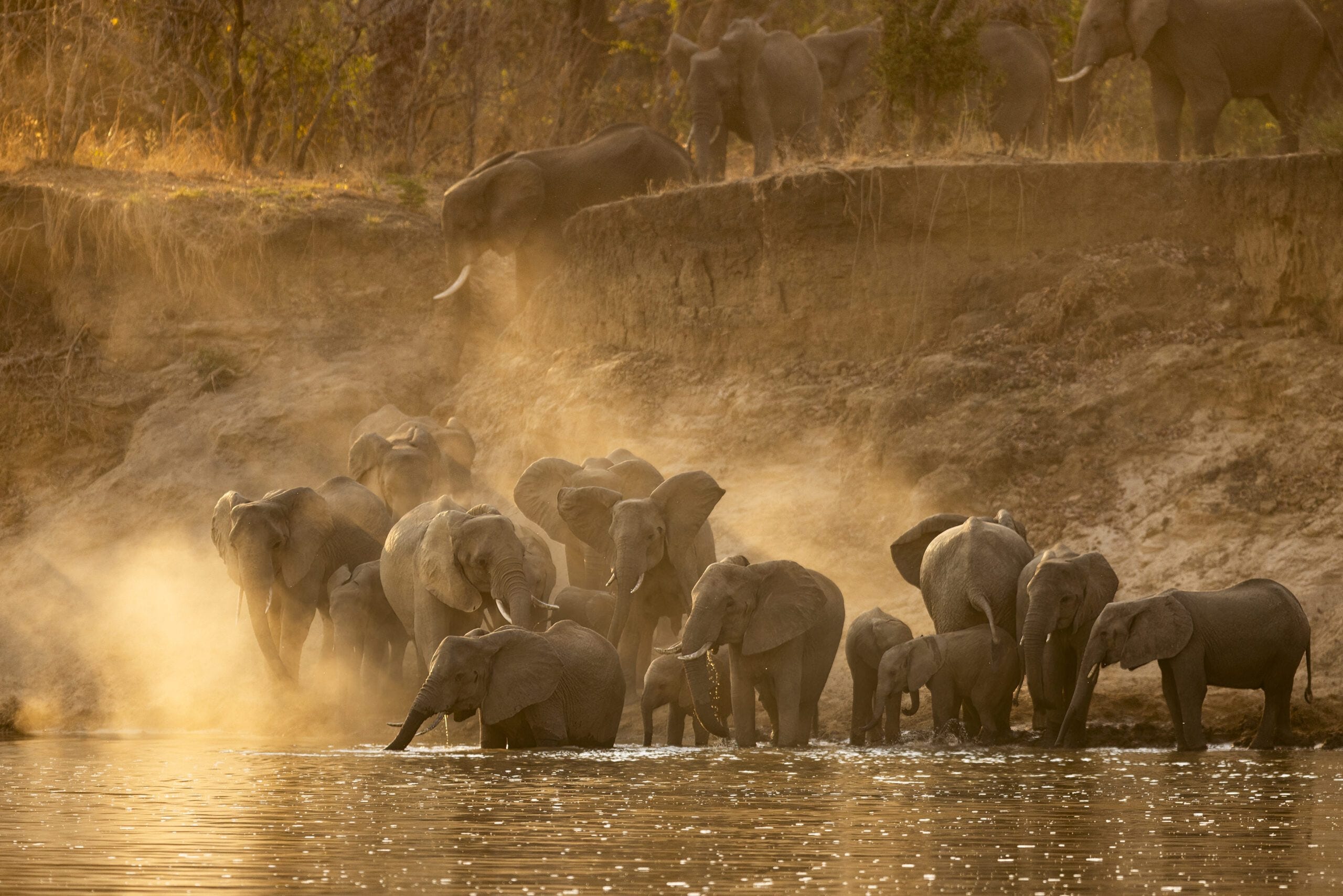
My family bought me, for my birthday, a print of a photo taken by Pete Downing from the David Shepherd Wildlife Foundation’s website. It echoes so much of what I saw in my dream. It will serve as a reminder of the many messages the dream world has for us, and more importantly, that we are all living the life of the herd.
If you want to purchase my new collection, you can only do so on my Website.
I